

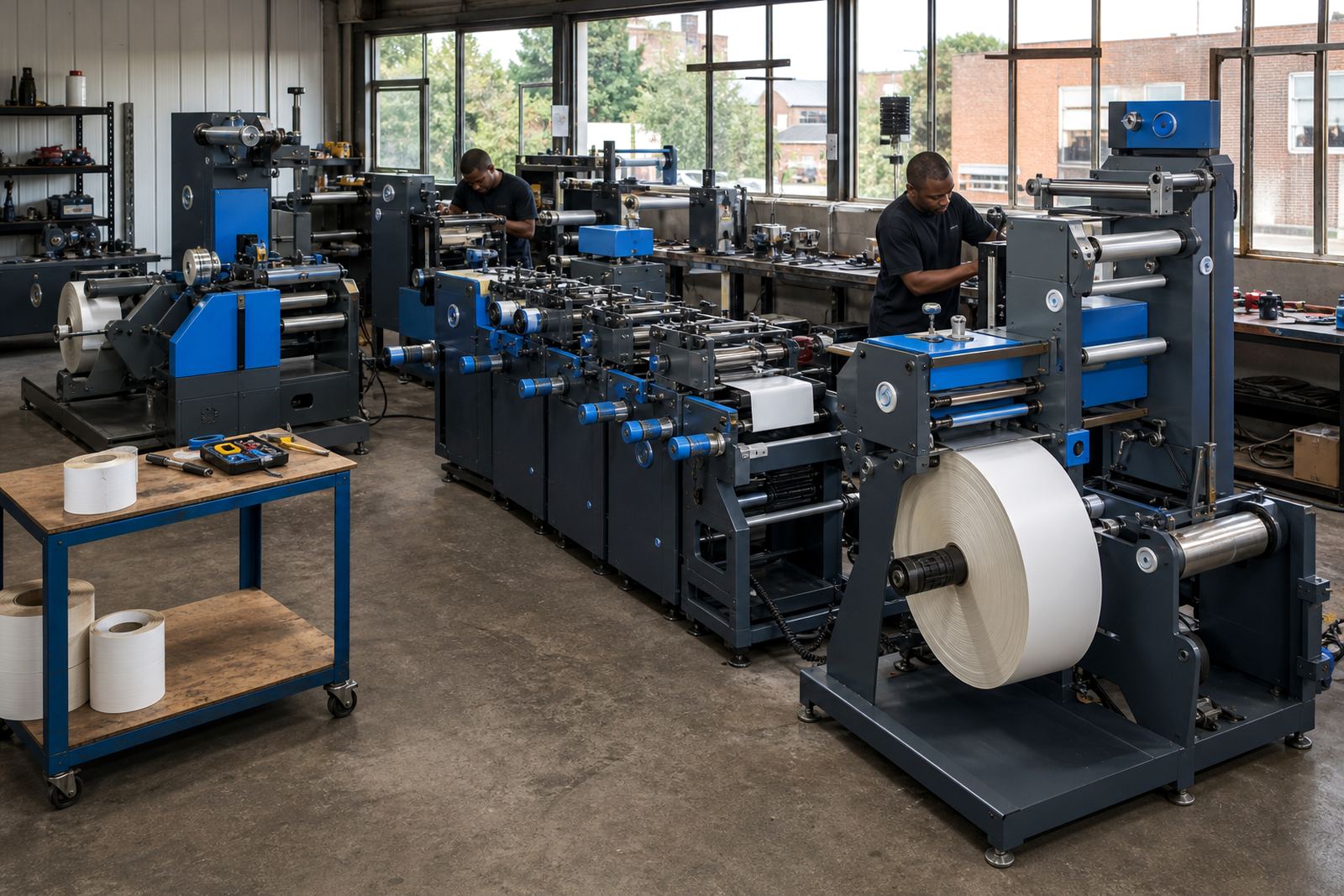
A workshop built around label finishing
Label-Cutter focuses on the finishing stage that turns printed label stock into saleable rolls. That means digital die-cutting, slitting, laminating, varnishing, matrix stripping and rewinding, all matched to the realities of short runs, mixed SKUs and changing substrates. The work is practical: keep the web straight, hold registration, protect the print, and finish the roll in a form the press room or pack line can use without extra handling.
From our base in Kya Sand, Randburg, we support operations in Johannesburg, Pretoria, Durban, Cape Town, Gqeberha and surrounding industrial areas. Clients reach us through the enquiry form on our contact page when they need machine advice, line support or parts for a finishing line that has to keep moving.
How the team handles a finishing line
Our work starts with the actual label format, roll build and output target. Some lines need semi-rotary die-cutting for repeat jobs and flexible dies, others lean on laser cutting for detailed shapes or short runs. In both cases, the aim is the same: clean edge quality, correct cut depth, stable register and a finished reel that winds neatly without telescoping or soft edges.
Thabo Mdlalose leads the business, with Karen Naidoo on sales, Pieter Pienaar on technical matters, Lerato Bhengu coordinating service, Musa Wessels handling operator training and Ayesha Shezi managing parts and logistics. That mix matters because a finishing line is not one machine on its own. Unwind tension, lamination, stripping, slitting and rewind settings all affect what comes off the last roll.
- Machine installation and line commissioning for new finishing equipment
- Operator training on setup, changeovers and daily checks
- Preventive maintenance to reduce stoppages and wear
- Breakdown repairs and remote support for live production issues
- Spare parts supply, die setup help and registration calibration
What a finished roll has to get right
In label converting, the roll itself is the final product. A clean slitting pattern matters when labels are narrow or the web is lightweight. A bad rewind shows up fast in storage, during packing, or at the application point. We pay attention to web path, tension zones, core alignment and waste removal because small errors build into bigger losses down the line.
We also work with registration marks, sensor settings and cut timing so print and die line up properly. When varnish or lamination is part of the build, the finishing process has to keep the surface stable and the edges tidy. Coastal humidity can affect certain stocks and adhesives, so the setup has to suit the material as it arrives, not just the sample on the bench.
Support that fits production, not the other way round
Our service work is meant to sit close to the production schedule. Some teams need a clean machine start after installation, others need a parts check, a set of spare blades, or help with a repeating registration fault. We look at the feed path, cut quality, stripping, winding and unwind control before making changes, because one adjustment can shift the whole line.
- Preventive maintenance on scheduled service intervals
- Remote troubleshooting for setup and control issues
- Rewind setup for stable roll build and storage
- Slitting setup for narrow webs and multi-up output
- Production optimisation for throughput, waste control and changeover discipline
We also work with teams that are introducing a new finishing method into an existing room. That can mean a laser unit, a semi-rotary module, or a finishing line that needs better handling around unwind and rewind stations. The goal is controlled output, not flashy machinery on its own.
The way we work with operators and maintenance teams
Good finishing depends on people as much as equipment. Operators need to understand registration marks, pressure settings, die setup, waste stripping and how to spot a winding problem early. Maintenance teams need clear notes on wear points, consumables and the parts that must be checked before a production run starts. We keep the language direct so the machine room is not left guessing.
Training covers the practical side of changeovers, web threading, lamination alignment, slit width checks and basic fault-finding. When the line is more complex, we spend time on sequence and timing, because a finishing machine that is tuned in the wrong order can look fine at first and drift out later. That sort of problem costs time and material, and it is usually avoidable.
From Kya Sand to sites across South Africa
Being based in Kya Sand, Randburg gives us access to the industrial areas around Johannesburg and the main freight routes into Gauteng, KwaZulu-Natal, the Western Cape and the Eastern Cape. We support local sites in Randburg, Midrand and Kempton Park, and we also work on production floors in Pretoria, Durban, Cape Town and Gqeberha when the job calls for it.
Label printers and packaging producers often run mixed jobs in a small space, with print, finishing and packing close together. That means the machine choice has to suit roll sizes, floor space, operator flow and the type of stock being used. We keep the advice grounded in the real room, not a brochure setup, and that usually saves a lot of back and forth.
Label-Cutter exists for operations that need label finishing to be steady, readable and ready for the next stage. Not every job needs the same machine path, and not every production room has the same pressures. What stays constant is the need for careful setup, proper support and equipment that can handle the work without making the room harder to run.