

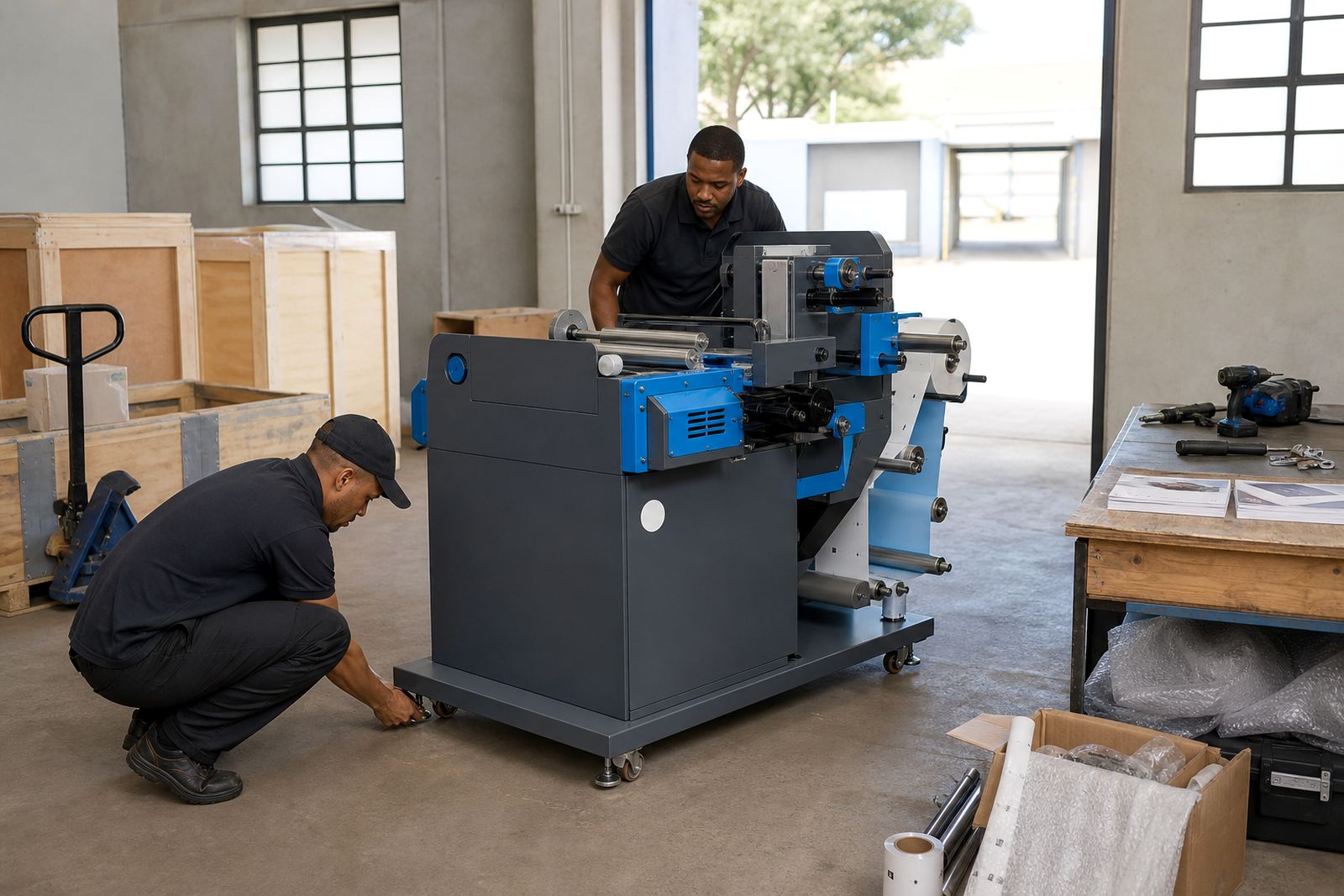
How the shop began
The first piece of equipment was set up to handle a small, practical order and check that each roll could be finished neatly. From there, the work grew around unwind and rewind paths, registration, accurate cutting and less waste. In 2003, in Kya Sand, Randburg, Label-Cutter was formed to support label printers and packaging producers with careful finishing of printed rolls. Those early jobs built a habit of testing, adjusting and checking every run until it performed properly.
That hands-on beginning gave the team a strong feel for the pressure points in label finishing. They learned how tension shifts, sticky coatings, foil carryover and small setup errors can interrupt a job. From the start, the focus was never on talk for its own sake. It was on understanding what the stock needed, how the press had behaved, and what the finished roll had to do next in production.
Craft built on detail
As label work became more varied, the craft grew beyond cutting alone. The business developed around finishing systems that could laminate, varnish, slit, strip waste and rewind while holding register and protecting the print. Some jobs call for short digital runs, while others need cleaner finishing for retail, food, personal care or industrial labels. The goal is always the same, to move from printed roll to usable roll without extra handling or avoidable loss.
That growth also meant learning which finishing method fits which job. Semi-rotary die-cutting suits many repeat applications, laser finishing supports different artwork demands and quick changeovers, and flexible dies still matter where edge control is critical. Each method brings its own checks. Materials can shift with heat or humidity, adhesives behave differently, and the line must still run steadily. The craft is in balancing those variables without overcomplicating the process.
Customers under production pressure
The customer base formed around people who feel finishing problems first. Label printers, packaging producers and converters work with tight schedules, changing artwork and jobs that need better control than older equipment can offer. Many need cleaner starts and stops, fewer manual touches and roll sizes that fit the next stage of production. Some are moving into digital label work for the first time, while others are replacing kit that no longer handles fine register or complex finishing well.
What those customers share is a need for control rather than show. A label roll must behave properly when it reaches slitting, rewinding or application, or the cost shows up quickly in waste and downtime. That is why the business keeps its conversations close to the real job. The team asks about stock, roll width, cores, adhesive type and operator routine, because small mismatches there can create repeated stoppages.
A team around the line
The business is led today by Thabo Mdlalose, with Karen Naidoo in sales, Pieter Pienaar overseeing technical work, Lerato Bhengu coordinating service, Musa Wessels handling applications training and Ayesha Shezi managing parts and logistics. That structure matters because digital label finishing is never handled well by one person alone. It crosses machine choice, installation, setup, training, support and spare parts, and each part has to connect cleanly for the line to perform as it should.
Sales stays grounded in what the machine can do in a real production bay. Technical support looks at alignment, cut depth, web path and registration. Training focuses on operator habits that protect the job, not theory for its own sake. Service keeps equipment in shape after installation, and parts handling helps avoid delays when something needs attention. The work is collaborative because the process itself is collaborative.
Support across the country
Being based in Kya Sand, Randburg has not limited the business to one area. Machines go into sites across Gauteng and further afield, and support follows where production teams need help. Different regions bring different conditions. Coastal humidity can affect material behaviour, while inland sites may run long shifts with tighter job turnover. That range has taught the team to think in terms of the production environment, not a single standard setting.
Support is therefore technical, but also calm and plain-spoken. The right tool, the correct die setup, accurate calibration on registration marks and a proper rewind path all matter. Miss one of those pieces and the line pays for it. A clear handover reduces that risk, and so does careful preparation before a machine is commissioned or a job is changed. The aim is steady output, not quick fixes that create new problems later.
No compromise on quality
What the company will not compromise on is accuracy, reliability and honest support. Label finishing has very little room for loose parts handling, vague instructions or rushed setup work. The team keeps close watch on cut depth, tension, registration, waste removal and rewind quality because each one affects the next step in production. If the roll is not right, the whole line feels it. That is why careful checking remains part of the culture, not an occasional extra.
The present work still carries the habits formed at the start. Test the job, adjust the settings, watch the result, and only then move forward. That approach keeps the business practical and grounded, even as customer needs change. It is a craft built on discipline, clear communication and a respect for how production really works. For Label-Cutter, the finish is not an afterthought. It is the point where the whole job proves itself.