

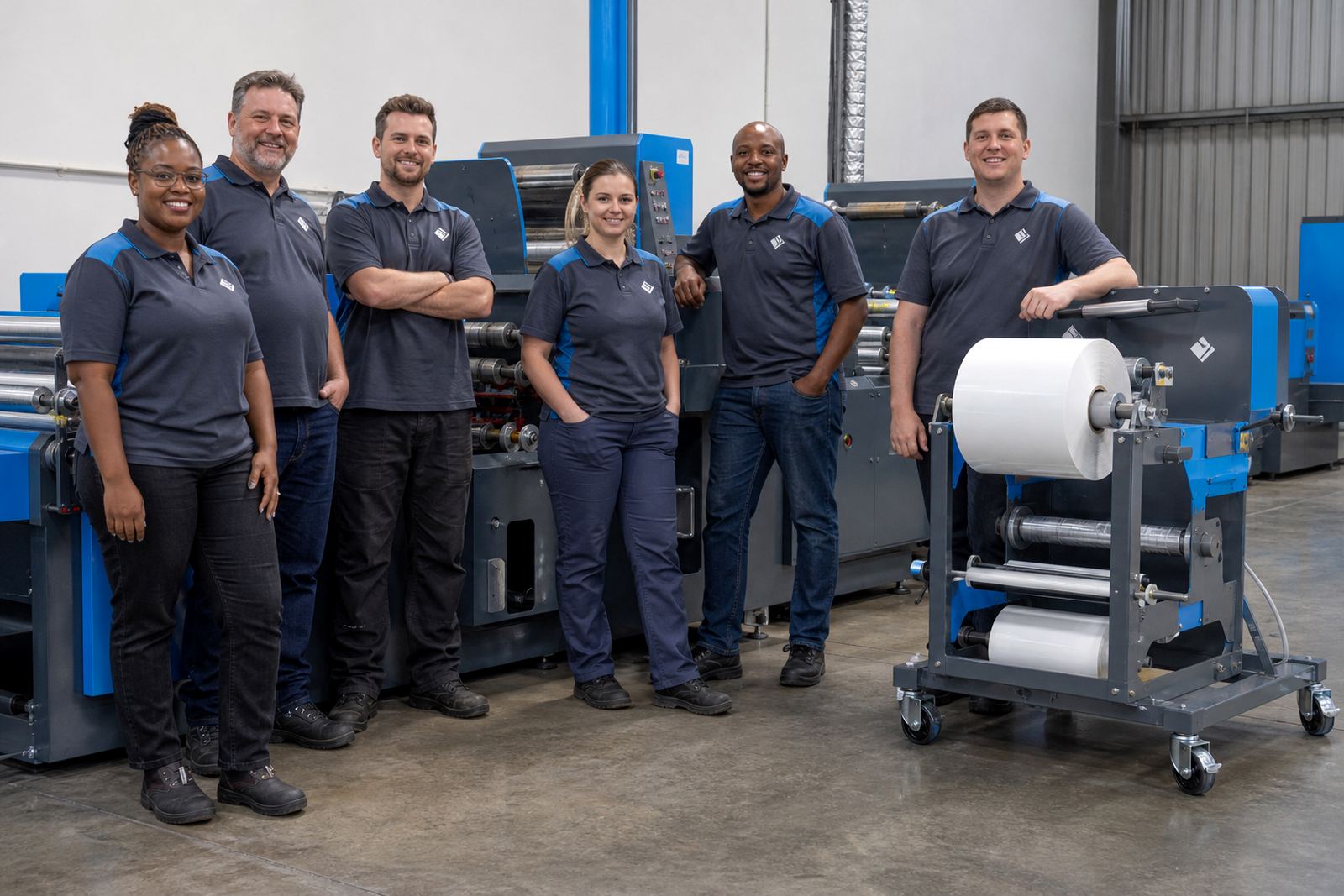
The people who keep the label line moving
Label finishing is never only about the machine frame. It is about the person setting the unwind, checking tension, aligning registration marks, watching the slitter and making sure the last roll leaves the line clean enough for print and pack. Our team works across that full chain, from first installation to day-to-day servicing in plants handling short runs, variable artwork and tighter roll widths.
Based in Kya Sand, Randburg, we work with digital label die-cutting and finishing systems used by printers and packaging producers. That means semi-rotary and laser die-cutting, lamination, varnish application, matrix stripping, slitting and rewinding, plus the smaller details that keep a line steady such as die setup, web path checks and rewind tension. The team knows the difference between a machine that is running and a line that is producing usable rolls.
- Machine installation and line commissioning
- Operator training on setup, changeovers and routine checks
- Preventive maintenance and breakdown repairs
- Remote support, spare parts supply and production optimisation
Thabo Mdlalose on the way the business is run
Thabo Mdlalose leads the business as Managing Director and keeps the work anchored in practical machine knowledge. He pays close attention to how a client line is being used, what the print room needs from its finishing side, and where a machine should be placed in relation to the rest of the workflow. His approach is direct and measured, with enough technical grounding to speak about registration, die wear, web control and output consistency without turning the conversation into noise.
He also keeps the team aligned across installation, support and service work in Johannesburg, Pretoria, Durban, Cape Town and Gqeberha. The aim is not theory for its own sake, but a line that can produce clean label rolls in real plant conditions, including mixed artwork, frequent format changes and the pressure of daily production.
- Client planning for new installations
- Escalation point for larger technical decisions
- Oversight of South African support coverage
Sales guidance that starts with the format, not the brochure
Karen Naidoo manages sales with a practical eye on what each business is producing and where the bottlenecks sit. A label printer may need a narrower web path, better slitting control or a finishing system that can handle both short digital jobs and longer production runs, while a packaging producer may want cleaner lamination and more stable rewind behaviour. Karen works from that level of detail, not broad sales talk.
She helps match the machine features to roll size, substrate type, finishing steps and the degree of automation the site can support. That includes the way a line handles matrix stripping, whether a semi-rotary setup is the better fit, and how the operator will move through the job without constant rework. Her focus is a fit that makes sense on the floor, not in a glossy comparison sheet.
- Matching features to production output
- Co-ordinating machine supply with service needs
- Supporting new and expanding label operations
Technical work that respects the details
Pieter Pienaar is the Technical Manager and spends his time around the parts of the machine that decide whether a job stays on spec. He works with die setup, registration calibration, slitting alignment, rewind stability and the sequence of steps that let a label roll move through the line without constant correction. On a busy production floor, that sort of attention matters more than a long explanation.
His work covers installation support, line commissioning and fault-finding on both new and existing equipment. When a machine is fitted into a plant, Pieter looks at the web path, the tension behaviour, the waste strip and the practical handling of rolls from start to finish. If the output needs to change from one label format to another, he knows where the adjustment usually sits.
- Die setup help and registration calibration
- Rewind and slitting setup
- Preventive maintenance planning
Service coordination that keeps jobs in motion
Lerato Bhengu coordinates service work, scheduling the practical follow-up that keeps machines productive after installation. That includes breakdown repairs, remote support, spare parts requests and the admin around preventive maintenance visits. She is often the steady hand between the client team and the technical side, making sure the right details are passed through before a technician heads out.
Musa Wessels handles applications training and operator support, which is where the machine meets the actual job. He shows operators how to load rolls, read registration marks, manage web tension and keep an eye on lamination, varnish, slitting and rewinding. The goal is confidence at the machine without overcomplicating the process, and enough understanding to keep the line running cleanly when formats change.
- Service planning and job coordination
- Operator training on setup and running
- Remote support for day-to-day production issues
Parts, logistics and the person who keeps the right piece moving
Ayesha Shezi leads parts and logistics, which matters when a site needs a component, a consumable or a replacement part to keep production moving. Her role links the technical side to stock handling and dispatch, especially where the machine has a narrow window for maintenance work between print jobs. Good parts control is not flashy, but it saves time and avoids avoidable delays on the floor.
The team works from Kya Sand, Randburg and supports clients across South Africa, including Johannesburg, Pretoria, Durban, Cape Town and Gqeberha, with support coverage also centred around Randburg, Midrand and Kempton Park. Across those areas, the same practical habits apply: clear machine setup, careful servicing and a proper understanding of how digital label finishing behaves in a real production environment.
From flexible dies to laser cutting, from varnish to waste stripping, the team handles the working parts of the process with enough experience to spot what matters and enough discipline to keep it tidy.